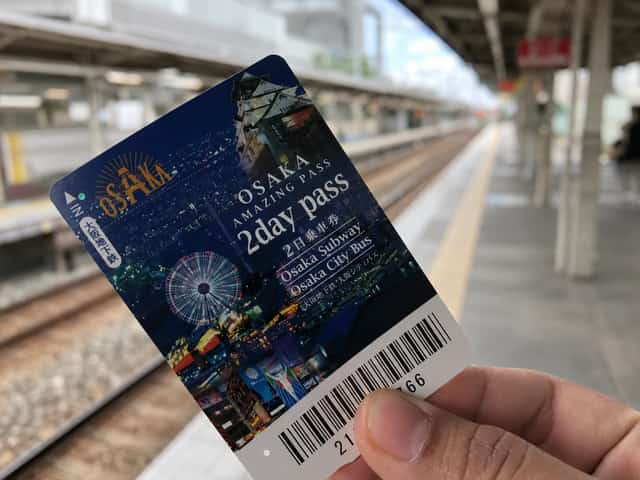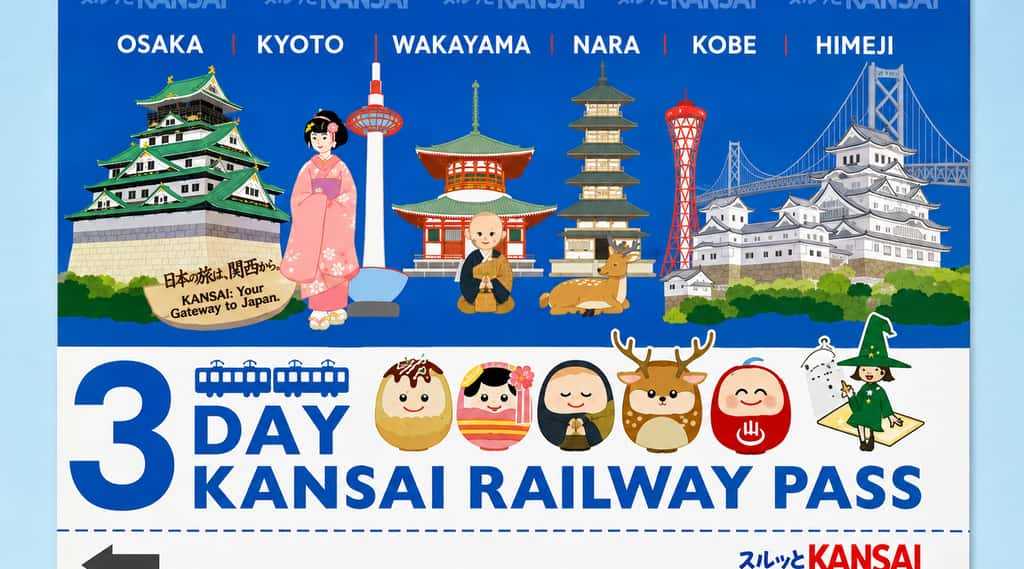
The KANSAI RAILWAY PASS LITE is worth buying only if you will make heavy use of covered private railways and metros for two or three consecutive days. It is no longer the broad, flexible Kansai transport pass many older guides describe.
The 2026 LITE version does not cover JR trains, Kyoto City Subway, Randen, the Keihan Otsu lines or buses. It is also now a smartphone-based QR ticket rather than a physical pass.
Current official prices are ¥5,200 (about US$32.64) for two days and ¥6,500 (about US$40.80) for three days. Klook currently lists them from around US$30.15 and US$37.69, respectively.
Best for most travellers: Do not buy the Kansai Railway Pass LITE automatically. Choose it when your itinerary deliberately uses private railways across Kansai on consecutive days. For a typical Osaka–Kyoto–Nara trip built around JR trains or lighter sightseeing days, compare a JR pass or pay-as-you-go IC card first.
USD conversions use the August 2026 rate of roughly ¥159 per US$1 and are approximate. Yen prices and sales dates were rechecked on the operator's site and JR West on 22 November 2026.
Kansai Railway Pass LITE Price: Quick Answer
| Pass | Official price | Current Klook price | Best for |
|---|---|---|---|
| 2-Day LITE | about US$32.64 (¥5,200) | from about US$30.15 | Two consecutive heavy travel days |
| 3-Day LITE | about US$40.80 (¥6,500) | from about US$37.69 | Best value if you can use all three consecutive days |
| JR Kansai Mini Pass | about US$18.83 (¥3,000) for 3 days | varies | JR-focused Osaka/Kyoto/Nara/Kobe trips |
| JR Kansai Area Pass (WEST QR) | about US$34.53 (¥5,500) for 3 days | varies | JR travel plus Kansai Airport Express HARUKA |
We checked the operator's site (surutto.com) and JR West on 22 November 2026. The current KANSAI RAILWAY PASS LITE edition is on sale from October 1, 2026 to March 31, 2027 at the same ¥5,200 and ¥6,500, and must be activated by March 31, 2027 (a two-day pass then runs to April 1, a three-day pass to April 2). What really separates it from the JR passes is the network: it covers private railways and metros, never JR.
Klook currently shows 400K+ bookings, 14.2K reviews and a 4.8/5 rating, but those numbers should not determine whether the pass fits your itinerary.
What Changed With the Kansai Railway Pass in 2026?
Quite a lot.
Older Kansai Railway Pass and Kansai Thru Pass guides can now be misleading because the 2026 KANSAI RAILWAY PASS LITE has materially different conditions.
1. It is now a digital QR pass
There is no physical LITE ticket to collect. The operator states that tickets are sold online and issued as e-tickets. You display a live QR code on your smartphone and scan it at compatible gates.
This means old instructions telling travellers to exchange a Klook voucher at KIX, Namba, Shin-Osaka or Kyoto counters no longer apply to the current LITE product.
2. The days must be consecutive
The 2026 two-day pass is for two consecutive days, while the three-day pass is for three consecutive days. Current official Chinese and Korean product pages explicitly state this, and Klook's 2026 listing also specifies consecutive use.
This is one of the most important changes because older versions could be much easier to fit around a mixed itinerary.
3. Buses are no longer included
The current official LITE product specifically states that buses cannot be used.
That substantially reduces its value for travellers whose Kyoto sightseeing relies on buses.
4. Kyoto City Subway is excluded
The operator also specifically excludes Kyoto City Subway.
This matters because a pass that works well for reaching Kyoto does not necessarily cover the transport you will use once you start sightseeing there.
5. The sales period is limited
Each edition is sold for about six months: the spring–summer 2026 edition ran from March 25 to September 30, 2026, and the current edition is on sale from October 1, 2026 to March 31, 2027. A pass is valid for three months from purchase.
2-Day vs 3-Day Kansai Railway Pass LITE
The three-day pass is the better value if you can genuinely use the third consecutive day.
At official pricing:
- 2 days: ¥5,200
- 3 days: ¥6,500
- Upgrade cost: only ¥1,300, about US$8.16
At the Klook prices visible during this update:
- 2 days: about US$30.15
- 3 days: about US$37.69
- Difference: only about US$7.44
That means the third day is relatively cheap.
Choose the 2-Day Pass if:
- You have exactly two consecutive regional sightseeing days.
- Your third day will mainly involve JR trains, buses or Kyoto City Subway.
- You are leaving Kansai after Day 2.
Choose the 3-Day Pass if:
- You have three consecutive days using covered private railways.
- You are moving between several Kansai cities.
- The third day would otherwise cost more than roughly US$7–8 in covered transport.
Best value: the 3-day pass.
Best risk-adjusted choice: the 2-day pass if you are unsure what transport you will use on Day 3.
What Does the Kansai Railway Pass LITE Cover?
The pass provides unlimited travel on participating metros and private railways across the eligible Kansai network, giving access to areas including Osaka, Kyoto, Nara, Kobe, Himeji and Wakayama.
That makes it potentially useful for itineraries built around private operators rather than JR.
Examples of useful private-rail corridors include routes operated by networks such as Hankyu, Hanshin, Kintetsu, Nankai and other participating Kansai operators. The official rules also specifically state that reserved-seat express services on Kintetsu, Nankai, Keihan and Hankyu require an additional fee.
Major exclusions
The current pass does not cover:
- JR trains
- Kyoto City Subway
- Randen / Keifuku Railway
- Keihan's Keishin and Ishiyama-Sakamoto lines
- Buses
- Certain other excluded railway sections
- Reserved-seat surcharges on applicable premium trains
The main catch is therefore not how large Kansai is. It is whether the specific operator serving your itinerary is covered.
Is Osaka Metro Included?
The LITE pass covers participating metro services, and the operator's current Osaka destination guidance uses Osaka Metro stations throughout its suggested sightseeing routes.
This makes the pass more useful for Osaka-heavy days than for Kyoto city sightseeing, where Kyoto City Subway and buses are specifically excluded.
Is the Kansai Railway Pass LITE Good for Kyoto?
Only for certain Kyoto itineraries.
The pass can work well when you enter Kyoto using covered private railways and continue to destinations accessible through those networks.
For example, the operator specifically recommends accessing Arashiyama via Hankyu, while noting that the pass does not cover Randen.
The problem is local sightseeing: Kyoto City Subway and buses are excluded.
Choose the pass for Kyoto if:
- Your hotel is near a covered private railway.
- You intend to use Hankyu, eligible Keihan sections or other covered private lines.
- Kyoto is one part of a broader Osaka/Kobe/Nara itinerary.
Skip it for Kyoto if:
- Most of your sightseeing depends on city buses.
- You plan to use Kyoto City Subway heavily.
- You are mainly travelling via JR Kyoto Station.
Kansai Railway Pass LITE vs JR Kansai Mini Pass
JR Kansai Mini Pass is cheaper for many straightforward JR-based itineraries.
JR West's current WEST QR Kansai Mini Pass costs only ¥3,000, about US$18.83, for three consecutive days. It covers ordinary JR trains, including Special Rapid and Rapid services, within its designated Kansai area. It does not include limited express trains or the Shinkansen.
| Feature | Kansai Railway Pass LITE | JR Kansai Mini Pass |
|---|---|---|
| 3-day official price | ¥6,500 | ¥3,000 |
| Main network | Private railways + participating metros | JR |
| Consecutive days | Yes | Yes |
| JR trains | No | Yes |
| Kyoto City Subway | No | No |
| Buses | No | No |
| Best for | Private-railway-heavy trips | JR-based Osaka/Kyoto/Nara/Kobe travel |
Choose Kansai Railway Pass LITE when:
Your itinerary works better with private railways such as Hankyu, Hanshin, Kintetsu or Nankai.
Choose JR Kansai Mini Pass when:
Your hotels and sightseeing destinations are convenient to JR stations and you do not need limited express trains.
Winner for budget: JR Kansai Mini Pass.
Winner for private-railway flexibility: Kansai Railway Pass LITE.
Kansai Railway Pass LITE vs JR Kansai Area Pass
The comparison becomes even more interesting if you are arriving through Kansai International Airport.
JR West stopped selling the paper JR Kansai Area Pass on September 30, 2026. Its replacement, the WEST QR Kansai Area Pass, is a smartphone QR ticket sold only through travel agencies outside Japan, at ¥2,700 for 1 day, ¥4,700 for 2 days, ¥5,500 for 3 days and ¥6,700 for 4 days.
It covers JR local, rapid and Special Rapid trains in its area and non-reserved seats on the Kansai-Airport Express HARUKA, plus up to two HARUKA reserved-seat bookings.
A three-day WEST QR Kansai Area Pass at ¥5,500, about US$34.53, is actually cheaper than the official ¥6,500 three-day Kansai Railway Pass LITE.
Choose JR Kansai Area Pass if: your itinerary is JR-heavy and HARUKA airport transport is useful.
Choose Kansai Railway Pass LITE if: private railway coverage matches your hotels and destinations better.
Kansai Railway Pass LITE vs ICOCA
ICOCA is usually the simpler choice when you are not travelling enough to justify an unlimited pass.
An IC card does not provide unlimited rides, so it is not automatically cheaper. Its advantage is that you are not forced to design three consecutive days around one pass's coverage.
For travellers mixing:
- JR
- private railways
- subways
- buses
- short local journeys
pay-as-you-go travel can be more practical even if the individual fares are not discounted.
The key question is therefore:
Will your covered fares exceed the cost of the LITE pass during its consecutive validity period?
If you cannot confidently answer yes, the LITE pass is probably unnecessary.
When Is the Kansai Railway Pass LITE Worth It?
The pass is strongest when all three of these conditions apply:
- You are travelling extensively for two or three consecutive days.
- Your routes mostly use covered private railways or metros.
- You are moving between multiple areas rather than staying within one neighbourhood.
Good itinerary patterns can include combinations of:
- Osaka + Kyoto
- Osaka + Nara
- Osaka + Kobe
- Kobe + Himeji
- Osaka + Wakayama
- routes toward Koyasan using eligible services
The official operator promotes the pass for travel across Osaka, Kyoto, Nara, Kobe/Himeji and Wakayama, including Koyasan as a major Wakayama destination.
When Should You Skip It?
Skip the pass if any of these describe your itinerary:
- You are staying mainly in one city.
- Your sightseeing days are not consecutive.
- You use JR for most intercity journeys.
- Your Kyoto itinerary depends heavily on buses or Kyoto City Subway.
- You only take a few train trips per day.
- You want a physical ticket.
- You cannot reliably keep your phone online and charged.
That final point matters more than it did with the old physical pass.
Deciding where to use the pass? Our day trips from Osaka guide gives train times and fares for Kyoto, Nara and Kobe, and shows where a tour is the better choice.
How to Use the Kansai Railway Pass LITE
The 2026 version is entirely smartphone-based.
Step 1: Buy the digital pass
The operator sells the LITE pass online only, through Klook, KKday, WAUG and Trip.com. Klook currently offers both the two-day and three-day versions.
Step 2: Open the ticket on your phone
You need:
- a working smartphone
- internet access
- browser camera permissions enabled
Step 3: Activate it after 3:00 a.m.
This rule is easy to misunderstand.
Each ticket day runs from 3:00 a.m. until 2:59 a.m. the following morning.
Do not start the pass between midnight and 2:59 a.m. expecting to continue after 3:00 a.m. The operator warns that if you activate during that period, the ticket cannot be used after 3:00 a.m.
Step 4: Scan the live QR code
At QR-compatible gates, display the ticket's QR code and scan it.
At stations without compatible gates, show the ticket to station staff for visual inspection.
Can You Use a Screenshot of the QR Code?
No.
The official rules specifically state that screenshots and printed screen images cannot be used as the ticket.
This makes phone battery and internet access genuine travel considerations.
Keep a power bank with you on long sightseeing days.
Do You Still Need to Pick Up the Pass at Kansai Airport?
No. Not for the current KANSAI RAILWAY PASS LITE.
The operator states that the current product is an e-ticket and is not issued in physical form.
Older advice about collecting the pass from KIX, Namba, Shin-Osaka or Kyoto exchange counters refers to previous versions and should not be followed for the 2026 LITE pass.
Are the Attraction Discounts Worth Anything?
They can help, but do not buy the pass solely for the discounts.
Current official examples include:
- 10% off Osaka Castle admission
- 10% off HARUKAS 300
- 10% off Himeji Castle admission
- discounted admission at participating Arima Onsen facilities
Klook currently advertises special offers at 350+ shops and attractions.
However, official terms state that facility offers are generally valid only on a day when the pass itself is being used, and individual offers can change.
Treat these discounts as a bonus, not the main reason to buy.
Refund and Cancellation Rules
Once you start using the pass, do not expect a refund.
The operator states that used tickets are non-refundable and that no refund is provided after activation even if transport is disrupted, a facility closes or bad weather affects the trip.
Klook's current listing says free cancellation before redemption for its two-day and three-day LITE packages.
Always check the exact cancellation terms shown for your booking before paying because OTA conditions can change.
Common Kansai Railway Pass Mistakes
1. Assuming it still works on non-consecutive days
It does not. The 2026 LITE version uses consecutive days.
2. Assuming buses are included
They are not.
3. Assuming Kyoto City Subway is included
It is specifically excluded.
4. Looking for a physical ticket pickup counter
The LITE pass is digital only.
5. Using a screenshot of the QR ticket
Screenshots are invalid.
6. Assuming every limited express is fully included
Reserved-seat express services on operators including Kintetsu, Nankai, Keihan and Hankyu can require additional fees.
7. Buying it because it says “unlimited”
Unlimited rides only matter inside the eligible network. A cheaper pass covering the routes you actually use can be better value.
8. Choosing the 2-day pass when Day 3 is also suitable
The official upgrade from two to three days costs only ¥1,300, while the current Klook price difference is around US$7.54.
Final Verdict: Is the Kansai Railway Pass LITE Worth It?
Yes, but for a narrower group of travellers than older versions of the pass.
For travellers doing two or three consecutive private-railway-heavy days across Kansai, the LITE pass can still be good value.
If you are buying it, the 3-Day Pass is the better value when you can use all three days because the upgrade from two days is relatively small.
However, for a typical first-time Osaka–Kyoto–Nara itinerary, do not assume the Kansai Railway Pass LITE is the default best pass. Compare your actual routes first.
Best for private-railway-heavy travel: Kansai Railway Pass LITE Best cheap JR option: JR Kansai Mini Pass Best for JR + HARUKA airport travel: JR Kansai Area Pass Best for maximum route flexibility: pay-as-you-go IC card
FAQ
Can I use the Kansai Railway Pass LITE on JR trains?
No. JR trains are excluded from the current KANSAI RAILWAY PASS LITE.
Can I use the Kansai Railway Pass LITE on Osaka Metro?
The pass covers participating metro services in Osaka, while the official sightseeing guidance lists Osaka Metro stations throughout its eligible Osaka itineraries.
Can I use the Kansai Railway Pass LITE on Kyoto City Subway?
No. Kyoto City Subway is specifically excluded from the 2026 LITE pass.
Can I use the Kansai Railway Pass LITE on buses?
No. The current LITE version does not cover buses.
Can I use the 2-day or 3-day pass on non-consecutive days?
No. Current official pages and Klook's 2026 listing specify consecutive use.
Is the Kansai Railway Pass LITE a physical ticket?
No. It is a smartphone-based e-ticket using a live QR code.
Do I need internet access?
Yes. The operator requires a working smartphone, network access and appropriate browser settings to use the digital ticket.
Can I show a screenshot of the QR ticket?
No. Screenshots and printouts are not accepted.
Is the Kansai Railway Pass valid for 48 or 72 hours?
No. It is based on consecutive operating days rather than rolling 24-hour periods. One ticket day is treated as 3:00 a.m. to 2:59 a.m. the following day.
Is the 3-day pass better than the 2-day pass?
Yes, if you can use the third consecutive day. The official upgrade costs only ¥1,300, and Klook currently shows a similarly small price difference.
When does the 2026 Kansai Railway Pass LITE stop selling?
The current edition is sold until March 31, 2027, and the pass must also be activated by that date.
Is the Kansai Railway Pass LITE better than the JR Kansai Mini Pass?
It depends on which railway network your itinerary uses. The Kansai Railway Pass LITE is better for private railways, while the three-day JR Kansai Mini Pass is much cheaper at ¥3,000 if JR routes suit your trip.
Written by

Former KLOOK Recommender System Expert
Built the systems that decided which products ranked first for users in KLOOK. That experience taught me that rankings just optimize clicks and conversions for OTA — not necessarily what truly fits each traveler. Today, I write evidence-based verdicts using my 4 year experience on product: whether they're worth it, who they suit, and when you're better off skipping them.