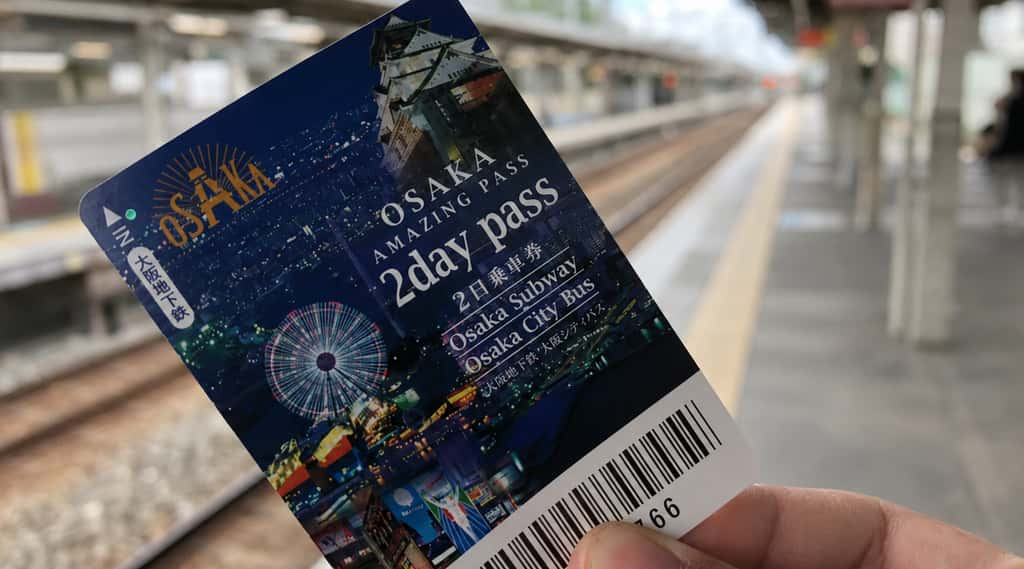
The Osaka Amazing Pass is worth buying if you plan to spend one or two full days actively sightseeing around Osaka. The standard pass currently costs ¥3,500 for 1 day and ¥5,000 for 2 consecutive days, or approximately US$21.83 and US$31.18 at current exchange rates. It includes unlimited travel on Osaka Metro, most Osaka City Bus routes and selected private railway sections, plus admission to around 40 participating attractions.
The important part is not the number of attractions. It is which attractions you actually plan to visit.
Best for most first-time visitors: Buy the 1-Day Osaka Amazing Pass if you can group at least three worthwhile attractions into one sightseeing day. Choose the 2-Day Pass if you genuinely have two consecutive full sightseeing days—the upgrade costs only ¥1,500, about US$9.36.
If your itinerary is lighter and mainly uses Osaka Metro, however, the cheaper Osaka e-Pass plus a Metro day pass can sometimes beat the Amazing Pass on price. More on that below.
Osaka Amazing Pass Prices: Quick Answer
| Pass | Official price | Approx. USD | Best for |
|---|---|---|---|
| 1-Day Osaka Amazing Pass | ¥3,500 | US$21.83 | One packed sightseeing day |
| 2-Day Osaka Amazing Pass | ¥5,000 | US$31.18 | Two consecutive sightseeing days |
| 1-Day Itami Airport version | ¥3,800 | about US$23.70 | ITM arrivals also visiting Expo ’70 Park |
| 2-Day Itami Airport version | ¥5,400 | about US$33.68 | Two sightseeing days plus relevant ITM/Expo transport |
The official 2026–27 passes are on sale from March 25, 2026 to March 31, 2027. They must generally be used within three months of purchase, subject to the final activation deadline. There is no separate child price.
USD conversions are approximate and exchange rates can change.
Klook currently lists the standard passes at around US$21.95 for 1 day and US$31.30 for 2 days, with a 4.7/5 rating from about 21.4K reviews and more than 1M bookings. Current prices can change, so treat these as live marketplace prices rather than fixed fares.
1-Day vs 2-Day Osaka Amazing Pass: Which Should You Buy?
Choose the 1-Day Pass if you can build one intensive sightseeing day
The 1-Day Pass is the safer choice for most visitors.
At ¥3,500, it does not take many higher-value attractions to recover the cost. Current regular adult prices include:
| Attraction | Regular price | Key restriction |
|---|---|---|
| Umeda Sky Building Observatory | ¥2,000 | Pass admission only until 15:00 |
| Tombori River Cruise | ¥2,000 | Time-slot exchange required; evenings can sell out |
| Tsutenkaku Observation Deck | ¥1,500 | Time-slot booking required |
| Tsutenkaku Tower Slider | ¥1,100 | Age/height/weight restrictions |
| Tsutenkaku Dive & Walk | ¥3,000 | Age, height, weight and clothing restrictions |
| Osaka Castle Museum | ¥1,200 | Includes Toyotomi Stone Wall Museum on the same day |
| Osaka-jo Gozabune Boat | ¥1,800 | Boarding-time ticket exchange required |
| Santa Maria Day Cruise | ¥1,800 | Weather and operating conditions apply |
For example, combining Umeda Sky Building (¥2,000) + Osaka Castle Museum (¥1,200) + Tombori River Cruise (¥2,000) + Tsutenkaku (¥1,500) represents ¥6,700, or roughly US$42, in regular admission before counting transportation.
That is where the Amazing Pass becomes easy to justify.
The catch is that sightseeing time, not ticket price, becomes your limiting factor. Trying to visit eight attractions simply because they are included usually creates a worse trip.
Choose the 2-Day Pass if both days are genuinely sightseeing days
The 2-Day Pass costs only ¥1,500 more than the 1-Day Pass.
That makes the upgrade attractive if Day 2 includes even one or two meaningful paid attractions plus transportation. It also lets you separate Osaka into logical clusters rather than spending the day crossing the city repeatedly.
A practical split is:
Day 1: Umeda → Osaka Castle → Namba/Dotonbori Day 2: Shinsekai/Tennoji → Osaka Bay
The 2-Day Pass must be used on two consecutive days. It is not a floating 48-hour pass. Each day is treated according to the pass's operating-day rules rather than as 24 hours from activation.
This matters particularly if you arrive in Osaka late. Activating a 2-Day Pass at night wastes much of the first sightseeing day.
Is the Osaka Amazing Pass Actually Worth It?
Yes, if you are visiting expensive included attractions
The easiest way to make the pass worthwhile is to prioritize attractions that would otherwise cost around ¥1,500–¥3,000.
A particularly strong example is Tsutenkaku Dive & Walk, which has a regular reference price of ¥3,000. Add even one other substantial attraction or several transport journeys and a ¥3,500 1-Day Pass can make financial sense quickly.
Probably not, if you only want Osaka Castle and one cheap attraction
Do not buy the pass simply because your itinerary contains Osaka Castle.
Osaka Castle Museum currently has a regular adult price of ¥1,200. Several other included museums and gardens cost only a few hundred yen individually. A traveller visiting only one or two lower-priced places may spend less by paying separately.
The pass is also less attractive for children
The Osaka Amazing Pass has no discounted child version—the same pass price applies regardless of age. Meanwhile, many individual attractions and public transport tickets do have cheaper child fares.
For families, calculate the children separately instead of automatically purchasing the same pass for everyone.
Osaka Amazing Pass vs Osaka e-Pass: The Difference That Actually Matters
The old rule of thumb that “Amazing Pass has more attractions and therefore is better” is too simplistic.
| Osaka Amazing Pass | Osaka e-Pass | |
|---|---|---|
| 1 day | ¥3,500 | ¥2,400 |
| 2 days | ¥5,000 | ¥3,000 |
| Included attractions | Around 40 | More than 25 |
| Osaka Metro / buses | Included | Not included |
| Selected private railways | Included | Not included |
| Best for | Intensive sightseeing + transport | Attraction-focused itineraries |
The Osaka e-Pass currently costs ¥2,400 for 1 day and ¥3,000 for 2 days, but transport is not included.
Osaka Metro's separate Enjoy Eco Card costs ¥820 on weekdays or ¥620 on Saturdays, Sundays and holidays.
That creates an interesting comparison:
On a weekday
1-Day e-Pass + Metro day pass: ¥2,400 + ¥820 = ¥3,220
1-Day Amazing Pass: ¥3,500
The combination is ¥280 cheaper.
On a weekend or public holiday
1-Day e-Pass + Metro day pass: ¥2,400 + ¥620 = ¥3,020
That is ¥480 cheaper than the Amazing Pass.
So why buy the Amazing Pass?
Because it covers more attractions and selected Hankyu, Hanshin, Keihan, Kintetsu and Nankai sections within its designated Osaka area, not merely Osaka Metro and city buses.
It also includes attractions that can materially change the calculation. Osaka Castle Museum and Tsutenkaku Dive & Walk, for example, are particularly relevant when comparing itineraries rather than merely counting the total number of facilities.
The better value is therefore itinerary-dependent:
- Choose Osaka e-Pass + Metro day pass for a lighter itinerary built mostly around overlapping e-Pass attractions and Osaka Metro.
- Choose Osaka Amazing Pass for a packed first-time itinerary, selected higher-value attractions and broader included transport.
- Do not buy either until you know which attractions you actually intend to visit.
Important Attraction Restrictions in 2026
This is where many Osaka Amazing Pass guides become misleading. “Included” does not necessarily mean “walk in at any time.”
Umeda Sky Building: go before 3 PM
The Kuchu Teien Observatory normally costs ¥2,000, but free admission with the Amazing Pass applies only until 15:00. From 15:00 onward, the pass provides a 10% admission discount instead.
If Umeda Sky Building is one of the attractions you are using to justify buying the pass, schedule it before 3 PM.
Tombori River Cruise: secure your departure early
The Tombori River Cruise currently operates roughly every 30 minutes from 11:00 to 21:00, but pass holders must exchange their pass for a boarding ticket with a designated departure time.
The operator specifically recommends exchanging earlier in the day because evening departures can sell out. Phone reservations are not accepted.
A useful strategy is to collect your evening cruise ticket while you are already in Dotonbori, continue sightseeing, then return for the assigned departure.
LEGOLAND Discovery Center Osaka: do not assume every date is free
LEGOLAND is one of the biggest traps in older Amazing Pass articles.
Free admission is available only on designated dates and, on some dates, only after a specified time. Other dates may provide only a discount rather than free entry. An advance date-and-time reservation is also required, and adults aged 16 or older cannot enter without a child aged 15 or younger.
Do not buy the Amazing Pass solely for LEGOLAND until you have checked your exact travel date.
Osaka Museum of Housing and Living is currently closed
The Osaka Museum of Housing and Living is listed as temporarily closed from September 1, 2026 through January 5, 2027.
Any itinerary published for autumn or winter 2026 that still treats it as a usable Amazing Pass attraction is outdated.
Cruises are vulnerable to weather and capacity
Several included cruises can be suspended because of weather, river conditions, sea conditions or maintenance. The official pass conditions warn that an attraction becoming unavailable does not generally trigger a refund for the pass.
Do not build your entire value calculation around one weather-dependent boat trip.
How to Use the Osaka Amazing Pass in 2026
The Osaka Amazing Pass is now a digital smartphone pass using SURUTTO QRtto. You need a powered smartphone, an internet connection and appropriate browser/camera access.
1. Buy the pass
Choose the 1-Day or 2-Day version.
Up to four tickets can be purchased in one official transaction, and unused tickets can be distributed before activation under the official system.
2. Do not activate it early
Open your ticket shortly before you actually intend to begin sightseeing and press Start Using.
A pass day runs from 3:00 AM to 2:59 AM the following morning. The official instructions specifically warn against starting the ticket between midnight and 2:59 AM because it will no longer work after 3:00 AM.
Most importantly, it is not valid for 24 hours or 48 hours from the moment you activate it.
3. Scan the QR code for trains
Open the Trains/Buses/Attractions section and scan the displayed QR code at compatible ticket gates when entering and exiting.
4. Scan or show it at attractions
At participating attractions, either show the QR code to staff or scan it at the designated terminal.
Some attractions still require a separate time-slot reservation or ticket exchange.
5. Keep your phone online
A live digital pass is required. Klook currently specifies that screenshots of the QR code are not accepted.
A power bank is therefore much more important with the current digital pass than it was with the old physical-card system.
What Transportation Does the Osaka Amazing Pass Include?
The standard pass includes unlimited use of:
- Osaka Metro
- Osaka City Bus, with some exclusions
- New Tram
- Eligible sections of Hankyu
- Hanshin
- Keihan
- Kintetsu
- Nankai
The private railway coverage is primarily within the designated Osaka area rather than unlimited travel across each operator's entire network.
Does it include JR trains?
No. JR lines are not included.
This matters around destinations where Google Maps may recommend JR because it is slightly faster. You may still need to choose an included Metro/private-rail route or pay separately for JR.
Does the Osaka Amazing Pass include Kansai Airport?
No. Do not treat the standard Osaka Amazing Pass as a Kansai Airport transfer pass.
Klook's current package information specifically excludes travel from Kansai Airport Station on the Nankai Line, and the special Itami version is also explicitly not valid at Kansai Airport.
What is the Itami Airport version?
The ITM version adds eligible transport including Osaka Monorail between Osaka Airport and Bampaku-kinen-koen, plus access connected with Expo ’70 Commemorative Park.
However, OSAKA WHEEL is currently closed for maintenance, so do not pay for the ITM version solely because you expect that attraction to be available.
A One-Day Osaka Amazing Pass Itinerary That Makes Sense
Rather than chasing the maximum number of attractions, build your day around geographical clusters and time-sensitive benefits.
A practical first-time route could look like this:
Morning — Umeda Visit Umeda Sky Building before the 15:00 free-entry cutoff.
Late morning / early afternoon — Osaka Castle Visit Osaka Castle Museum and, if timing works, add the Osaka-jo Gozabune Boat.
Afternoon — Namba and Dotonbori Exchange your Tombori River Cruise ticket early rather than waiting until evening.
Late afternoon — Shinsekai Visit Tsutenkaku. Add the Tower Slider or Dive & Walk if these attractions suit you.
Evening — Dotonbori Return for your assigned river-cruise departure.
The reason this itinerary works is not merely that it uses many inclusions. It also avoids one of the most common pass mistakes: arriving at a reservation-sensitive attraction at night and discovering that the remaining slots are gone.
If you'd rather spend a day outside the city, our day trips from Osaka guide compares train and tour for Kyoto, Nara, Kobe, Himeji and further afield.
When You Should Skip the Osaka Amazing Pass
Skip it if:
- You are spending most of the day at Universal Studios Japan.
- You only plan to visit one or two low-cost attractions.
- Your itinerary relies heavily on JR.
- You mainly want attractions already covered by the cheaper Osaka e-Pass and are happy to buy Metro transportation separately.
- You arrive late and would waste much of the pass day.
- You are buying it primarily for a date-restricted attraction without checking availability first.
- You prefer a slow itinerary with long meals, shopping and neighbourhood wandering rather than attraction hopping.
A sightseeing pass saves money only when your itinerary matches it.
Final Verdict: Which Osaka Amazing Pass Should You Buy?
For most first-time visitors doing a full sightseeing day in central Osaka, the 1-Day Osaka Amazing Pass is the best default choice.
At ¥3,500, combining several major attractions can recover the pass price without having to race through an unrealistic number of sights. Unlimited transport also removes repeated fare decisions during the day.
Choose the 2-Day Pass when you have two consecutive full days and want to split the city into logical areas. The extra day costs only ¥1,500, making the upgrade much easier to justify than buying two separate 1-Day passes.
But do not assume the Amazing Pass is automatically Osaka's cheapest sightseeing product. For travellers whose chosen attractions overlap heavily with the Osaka e-Pass and who mainly use the Metro, e-Pass + a Metro day ticket can cost slightly less.
The correct question is therefore not “How many attractions are included?”
It is:
Which attractions will I actually use, and what would those attractions plus my transport cost without the pass?
FAQ
Is the Osaka Amazing Pass worth it for one day?
Yes, if you plan a packed sightseeing day. Two higher-priced attractions can put you close to the ¥3,500 pass price, while three or four meaningful attractions plus transportation can produce substantial savings.
Is the 2-Day Osaka Amazing Pass worth upgrading to?
Usually yes if you have two consecutive full sightseeing days. The upgrade from the 1-Day Pass costs only ¥1,500, about US$9.36.
Is the Osaka Amazing Pass valid for 24 hours?
No. A 1-Day Pass is not valid for 24 hours from activation, and the 2-Day Pass is not valid for 48 hours. Pass days follow the official daily validity rules.
Can I use the Osaka Amazing Pass on JR trains?
No. JR services are not included.
Can I use the Osaka Amazing Pass to travel from Kansai Airport?
Not as an included airport transfer. Travel from Kansai Airport Station is outside the included coverage described for the pass.
Can I use the Osaka Amazing Pass at Umeda Sky Building after 3 PM?
You can use it for a discount, but not free admission. Pass admission is available only until 15:00; afterward the current benefit is 10% off admission.
Is LEGOLAND Discovery Center Osaka always free with the pass?
No. Free-entry dates and eligible times are restricted, and advance reservations are required. Check the current schedule for your exact travel date before relying on LEGOLAND when calculating pass value.
Do I need a smartphone?
Yes. The current Osaka Amazing Pass is a digital service and requires a mobile device.
Can I use a screenshot of the QR code?
Do not rely on screenshots. Current digital-pass instructions require an internet-connected smartphone, and Klook states that screenshots of the QR code are not accepted.
Can I get a refund?
Unused official tickets can be refunded within their validity period, but refunds are no longer available after activation. Klook currently also lists free cancellation before redemption for its Amazing Pass packages.
Is Osaka Amazing Pass better than Osaka e-Pass?
The Amazing Pass is better for broader sightseeing plus transport; the e-Pass can be cheaper for attraction-focused travellers. The e-Pass does not include public transportation, while the Amazing Pass includes eligible Metro, bus and private-rail travel.
Written by

Former KLOOK Recommender System Expert
Built the systems that decided which products ranked first for users in KLOOK. That experience taught me that rankings just optimize clicks and conversions for OTA — not necessarily what truly fits each traveler. Today, I write evidence-based verdicts using my 4 year experience on product: whether they're worth it, who they suit, and when you're better off skipping them.