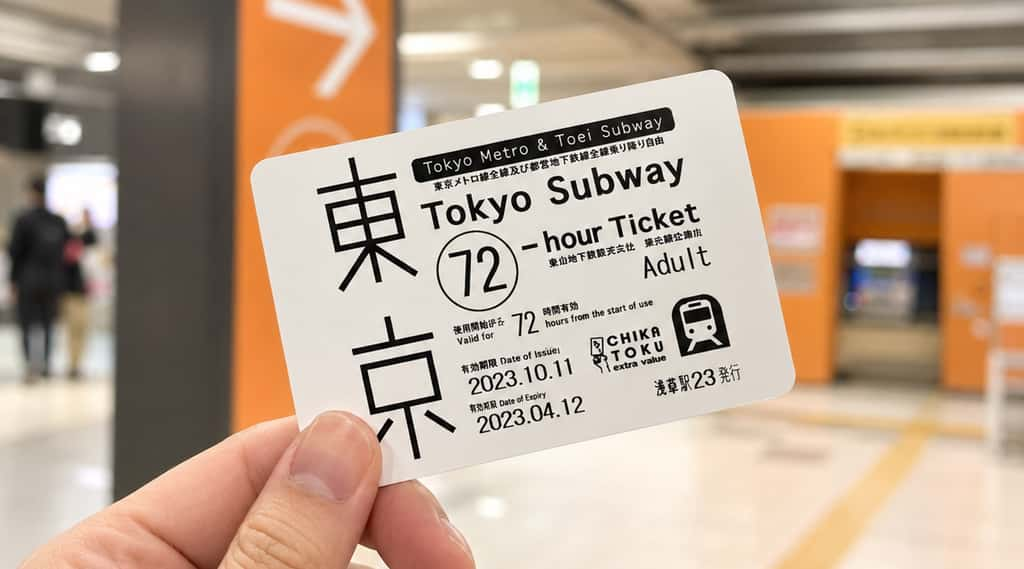
The Tokyo Subway Ticket is worth buying if you will make frequent trips on Tokyo Metro and Toei Subway lines, but it is not a replacement for Suica.
Current official adult prices are ¥1,000 for 24 hours, ¥1,500 for 48 hours and ¥2,000 for 72 hours—approximately US$6.28, US$9.42 and US$12.55 at the exchange rate used for this August 2026 update. The ticket covers all Tokyo Metro and Toei Subway lines but does not cover JR trains, including the Yamanote Line.
Best for most travellers: If you have three busy sightseeing days in central Tokyo and your hotel is convenient to Metro/Toei stations, choose the 72-hour ticket. If you expect to mix JR, buses, airport trains and other operators extensively, use Suica or Welcome Suica instead—or keep one as a backup alongside the Subway Ticket.
USD conversions are approximate and exchange rates can change.
Tokyo Subway Ticket Prices: Quick Answer
| Ticket | Official adult price | Approx. USD | Best for |
|---|---|---|---|
| 24 hours | ¥1,000 | US$6.28 | One packed sightseeing day |
| 48 hours | ¥1,500 | US$9.42 | Two consecutive Tokyo sightseeing days |
| 72 hours | ¥2,000 | US$12.55 | Best overall for three subway-heavy days |
Children pay half price: ¥500, ¥750 and ¥1,000 respectively.
We checked these prices against Tokyo Metro on 21 November 2026. What really separates the options is whether your days stay on Tokyo Metro and Toei: the ticket covers nothing on JR, and at the lowest ¥178 IC fare the 72-hour ticket needs about four subway rides a day to beat paying per ride.
The prices above took effect on March 14, 2026. Before that change, the same adult tickets cost ¥800, ¥1,200 and ¥1,500.
The 72-hour pass is particularly attractive because upgrading from 48 hours costs only ¥500, about US$3.14.
24 vs 48 vs 72 Hours: Which Should You Buy?
24-Hour Ticket: Best for One Intensive Sightseeing Day
Choose the 24-hour pass when you have one day with frequent Metro and Toei journeys.
It costs ¥1,000, while normal Tokyo Metro IC fares currently start at ¥178 and rise according to distance. At that lowest fare, the 24-hour ticket pays off once you make six rides within 24 hours; longer rides cost more, so fewer can be enough.
Good examples include days combining several areas such as:
- Asakusa
- Ueno
- Ginza
- Shibuya
- Shinjuku
- Roppongi
The important advantage is that this is a 24-hour ticket, not a calendar-day ticket. Its validity begins when you first use it rather than automatically ending at midnight.
That means a pass first used at 2:00 p.m. can remain valid until around 2:00 p.m. the next day.
The catch: the clock continues overnight. Activating it late in the evening can waste a substantial part of its validity while the subway is not operating.
48-Hour Ticket: Best for a Two-Day City Break
At ¥1,500, about US$9.42, the 48-hour ticket costs only ¥500 more than the 24-hour version.
At the lowest ¥178 IC fare, it pays off at around five subway rides per 24-hour period.
Choose 48 hours if:
- You have two full Tokyo sightseeing days.
- Your accommodation is near a Metro or Toei station.
- Most attractions on those days are inside the subway network.
- Day 3 will be used for an airport transfer, Disneyland or another journey outside the core subway network.
Best compromise: 48 hours if you are uncertain about how much subway travel you will do on your third day.
72-Hour Ticket: Best Value for Most Subway-Heavy Trips
The 72-hour ticket is the strongest value of the three when you can use it properly.
It costs ¥2,000, about US$12.55, just ¥500 more than the 48-hour option.
At the lowest ¥178 IC fare, it pays off at around four subway rides per 24-hour period.
Upgrade from 48 to 72 hours if:
- Day 3 includes another full day of central Tokyo sightseeing.
- You will use Metro/Toei at least several times.
- Your hotel remains close to a covered station.
Skip the upgrade if:
- Day 3 is mostly Disneyland or DisneySea.
- You are taking a long-distance JR trip.
- You are leaving Tokyo early.
- Your itinerary relies heavily on JR rather than subway lines.
Winner for most three-day Tokyo sightseeing itineraries: 72 hours.
What Changed With the Tokyo Subway Ticket in 2026?
Two changes matter most.
1. Prices increased in March 2026
From March 14, 2026:
| Ticket | Old price | Current price |
|---|---|---|
| 24 hours | ¥800 | ¥1,000 |
| 48 hours | ¥1,200 | ¥1,500 |
| 72 hours | ¥1,500 | ¥2,000 |
These are official Tokyo Metro/Toei prices.
Older articles quoting ¥800, ¥1,200 or ¥1,500 should therefore not be used for current trip budgeting.
2. QR Tickets Can Now Be Used Directly at the Gate
From March 25, 2026, Tokyo Metro and Toei expanded QR ticketing to include the Tokyo Subway Ticket. A supported QR ticket can now be purchased and used entirely on a digital device without first converting it into a paper ticket.
For the official QR version:
- Select the ticket in your account.
- Press the button to begin use.
- Display the QR code.
- Scan it at a QR-compatible automatic gate.
- The 24-, 48- or 72-hour period begins with the first entry through the gate.
The official QR ticket can be started on a day of your choice within 90 days of purchase.
E-Ticket vs Physical Ticket: Which Is Better?
Choose the e-ticket unless the physical ticket is meaningfully cheaper.
Klook currently lists both:
- E-ticket, adult/child
- Physical ticket, adult/child
- Discounted physical-ticket options for adults on some packages
Choose the e-ticket if:
- You want to go directly to the gate.
- You do not want to find a redemption machine.
- You are comfortable relying on your phone.
Choose the physical ticket if:
- Klook is offering a worthwhile discount.
- You prefer not to rely on phone battery during the day.
- You do not mind exchanging your voucher first.
Klook's current page advertises discounts of up to 11% on some adult physical-ticket options, although availability and package pricing can vary.
Better convenience: e-ticket.
Potentially better price: check the physical-ticket option before paying.
Do Klook Tickets Still Need to Be Redeemed?
It depends on which package you buy.
Klook currently offers both e-ticket and physical-ticket packages. Its newer e-ticket option can be used digitally, while a physical-ticket voucher still requires redemption.
For the physical-ticket product, Klook's current FAQ says the voucher can be redeemed for up to 365 days after purchase, and after exchange the physical pass has a separate validity period before activation.
Do not confuse that with the official QR ticket's 90-day activation window.
The practical rule is simple:
Check whether your checkout page says “E-ticket” or “Physical ticket.” The usage instructions are different.
What Does the Tokyo Subway Ticket Cover?
The ticket gives unlimited travel on:
- All Tokyo Metro lines
- All Toei Subway lines
Together, Klook currently describes this as 13 subway lines and more than 280 stations.
For typical visitors, that gives convenient subway access to areas such as:
| Area | Useful subway access |
|---|---|
| Shibuya | Tokyo Metro |
| Shinjuku | Tokyo Metro + Toei |
| Asakusa | Tokyo Metro + Toei |
| Ginza | Tokyo Metro |
| Ueno | Tokyo Metro |
| Roppongi | Tokyo Metro + Toei |
| Oshiage / Tokyo Skytree area | Tokyo Metro + Toei |
| Tokyo Station | Tokyo Metro Marunouchi Line |
What Is NOT Included?
JR is not included.
That means the Tokyo Subway Ticket does not cover JR lines such as the Yamanote Line. Klook and the official ticket information both restrict unlimited travel to Tokyo Metro and Toei Subway.
It also does not turn journeys on unrelated railway operators into free rides simply because a train runs through onto a subway line. Outside the Tokyo Metro/Toei valid area, another fare may be required. This follows from the pass's official valid-area restriction to those two subway networks.
This matters particularly for:
- airport journeys
- JR-heavy itineraries
- destinations outside central Tokyo
- journeys using non-subway operators
Tokyo Subway Ticket vs Suica: Which Is Better?
Tokyo Subway Ticket is better for savings; Suica is better for flexibility.
| Feature | Tokyo Subway Ticket | Suica / Welcome Suica |
|---|---|---|
| Payment | Unlimited travel | Pay per ride |
| Tokyo Metro | Included | Yes, fare deducted |
| Toei Subway | Included | Yes, fare deducted |
| JR | Not included | Supported on compatible JR routes |
| Buses | Not included as part of pass | Supported on compatible buses |
| Other IC-compatible railways | No | Broad compatibility |
| Shopping | No | Yes |
| Best for | Intensive central Tokyo sightseeing | Mixed transport itineraries |
JR East describes Suica as a stored-value IC card usable for trains, buses and shopping. Welcome Suica also works on compatible transport networks beyond Tokyo and at participating shops, vending machines and lockers.
Choose Tokyo Subway Ticket if:
- Your itinerary mainly follows Metro and Toei lines.
- You expect several rides per day.
- You want a fixed transportation cost.
- You are spending two or three packed sightseeing days in central Tokyo.
Choose Suica if:
- You expect frequent JR travel.
- Your itinerary uses buses or different railway companies.
- You want one card for transport and small purchases.
- You value simplicity more than maximizing a specific pass.
Should you buy both?
It can make sense, but only if the Subway Ticket will save you money.
Use the Tokyo Subway Ticket for covered journeys and Suica for occasional JR or other uncovered transport.
Do not buy an unlimited pass simply because you already have Suica. First check whether your Metro/Toei usage is high enough to justify the extra ¥1,000–¥2,000.
Should You Skip JR to Get More From the Pass?
Both Shibuya and Shinjuku have subway access, so you do not need JR to reach them.
However, route-planning apps sometimes suggest the Yamanote Line because it can be faster or simpler from your starting point.
If you own the Subway Ticket and want to maximize its value, check whether a Metro or Toei alternative is reasonable before automatically boarding JR.
Do not take a much slower route just to “save” a small fare. Time also has value.
Is the 72-Hour Tokyo Subway Ticket Worth It?
Yes, for three active sightseeing days inside the subway network.
At ¥2,000, the ticket works out to roughly ¥667 per day, about US$4.18, if you use all three days.
At the lowest ¥178 IC fare, about four subway rides per 24-hour period are enough for the 72-hour ticket to beat paying per ride.
That makes it particularly suitable for first-time itineraries where you change districts several times per day.
It becomes much less useful if one or more days are primarily outside the subway network.
Does the Pass Expire at Midnight?
No.
The 24-, 48- and 72-hour tickets operate on rolling hours from the start of use, rather than ending at midnight.
For example:
- First use Monday 10:00 a.m.
- 24-hour ticket: approximately until Tuesday 10:00 a.m.
- 48-hour ticket: approximately until Wednesday 10:00 a.m.
- 72-hour ticket: approximately until Thursday 10:00 a.m.
This is one of the biggest advantages over a calendar-day transportation pass.
When Should You Activate It?
Activate it immediately before your first useful subway journey.
Do not activate the ticket:
- at the airport if your airport train is not covered
- the night before sightseeing
- simply because you have arrived in Tokyo
Because the validity is measured continuously in hours, a later start can sometimes cover part of an additional morning.
Tokyo Subway Ticket + Skyliner: Is the Combo Worth It?
A Subway Ticket alone does not provide a complete Narita Airport transfer.
There is an official Keisei Skyliner + Tokyo Subway Ticket product combining the airport train with 24-, 48- or 72-hour subway access. Current one-way adult prices include:
- Skyliner + 24-hour Subway Ticket: ¥3,100, about US$19.46
- Skyliner + 48-hour Subway Ticket: ¥3,600, about US$22.60
- Skyliner + 72-hour Subway Ticket: ¥4,100, about US$25.74
Klook also currently sells Skyliner combinations with Tokyo Subway Tickets.
Choose the combo if: you are arriving at Narita, Skyliner is convenient for your hotel and you already planned to buy the subway pass.
Skip it if: another airport route is more convenient for your accommodation.
Who Can Buy a Tokyo Subway Ticket?
The ticket is primarily designed for travellers.
Official sales include overseas visitors and qualifying domestic visitors whose residence is outside Tokyo and seven surrounding prefectures, although eligibility can depend on the sales channel.
Klook currently states that its offer is not available to Japanese passport holders.
For most international tourists visiting Japan, this is straightforward.
Tokyo Subway Ticket for Children
Current official child prices are:
- 24 hours: ¥500, about US$3.14
- 48 hours: ¥750, about US$4.71
- 72 hours: ¥1,000, about US$6.28
Under Tokyo Metro’s age rules, children under six who are not yet at elementary school ride free, up to two per accompanying adult or child; a third such child, or one riding alone, pays the child fare.
Common Tokyo Subway Ticket Mistakes
1. Assuming it includes the Yamanote Line
It does not. JR lines are outside the pass.
2. Buying 24 hours when 48 hours costs only ¥500 more
If you have another full sightseeing day, the upgrade is often better value.
3. Buying 48 hours when the 72-hour upgrade is only ¥500
If Day 3 is subway-heavy, 72 hours is usually the better purchase.
4. Treating it as a calendar-day pass
It is valid for rolling 24-, 48- or 72-hour periods from first use.
5. Activating it late at night
The validity clock continues while you sleep.
6. Following old “physical ticket only” instructions
QR gate entry became available in March 2026.
7. Assuming every Klook package has the same redemption rule
Klook currently offers both e-tickets and physical-ticket products.
8. Buying it because millions of other travellers did
Klook currently shows 3M+ bookings, 88.6K reviews and a 4.8/5 rating. That is useful social proof, but it does not tell you whether your own routes are covered.
Final Verdict: Which Tokyo Subway Ticket Should You Buy?
For three busy sightseeing days in central Tokyo, choose the 72-hour Tokyo Subway Ticket.
At ¥2,000, about US$12.55, it offers the strongest per-day value and costs only ¥500 more than the 48-hour option.
Choose 48 hours when your third day is outside Tokyo's core subway network.
Choose 24 hours for one particularly intensive sightseeing day.
Choose Suica instead if your routes frequently use JR, buses or several different railway operators.
For many first-time travellers, the most practical setup is:
Tokyo Subway Ticket for heavy Metro/Toei sightseeing + Suica as a backup for uncovered journeys.
FAQ
How much is the Tokyo Subway Ticket in 2026?
The official adult prices are ¥1,000 for 24 hours, ¥1,500 for 48 hours and ¥2,000 for 72 hours, approximately US$6.28, US$9.42 and US$12.55 at the exchange rate used for this update.
Did the Tokyo Subway Ticket price increase in 2026?
Yes. Prices increased on March 14, 2026 from ¥800/¥1,200/¥1,500 to ¥1,000/¥1,500/¥2,000.
Is the Tokyo Subway Ticket worth it?
Yes if you use Tokyo Metro and Toei Subway frequently. At the lowest ¥178 IC fare, the 24-hour ticket pays off at six rides, while the longer tickets need fewer rides per day to justify their cost.
Does the Tokyo Subway Ticket include JR?
No. JR lines, including the Yamanote Line, are not included.
Does the Tokyo Subway Ticket include both Tokyo Metro and Toei Subway?
Yes. Unlimited rides on all lines of both subway systems are included during the ticket's validity.
Is the 72-hour ticket valid for three calendar days?
No. It is valid for 72 continuous hours from first use.
Can I use the Tokyo Subway Ticket on my phone?
Yes, if you purchase the QR/e-ticket version. QR direct gate entry became available on March 25, 2026.
Do I still need to exchange a Klook voucher?
Only for a physical-ticket package. Klook now also lists an e-ticket option, so check the package type before booking.
Is Tokyo Subway Ticket better than Suica?
It is better for unlimited Metro/Toei travel; Suica is better for network flexibility. Suica can be used across compatible trains, buses and shops, whereas the Subway Ticket is limited to Tokyo Metro and Toei Subway.
Should I buy both Suica and a Tokyo Subway Ticket?
Only if the Subway Ticket will save you money. The Subway Ticket can handle your covered sightseeing journeys while Suica pays for occasional JR or other uncovered trips.
Is the 72-hour ticket better value than the 48-hour ticket?
Yes, if you need the third day. The upgrade costs only ¥500, about US$3.14.
Can I use the Tokyo Subway Ticket to Narita Airport?
Not by itself. Narita airport rail travel is outside the standard Metro/Toei pass, although Skyliner + Tokyo Subway Ticket combination products are available.
Written by

Former KLOOK Recommender System Expert
Built the systems that decided which products ranked first for users in KLOOK. That experience taught me that rankings just optimize clicks and conversions for OTA — not necessarily what truly fits each traveler. Today, I write evidence-based verdicts using my 4 year experience on product: whether they're worth it, who they suit, and when you're better off skipping them.