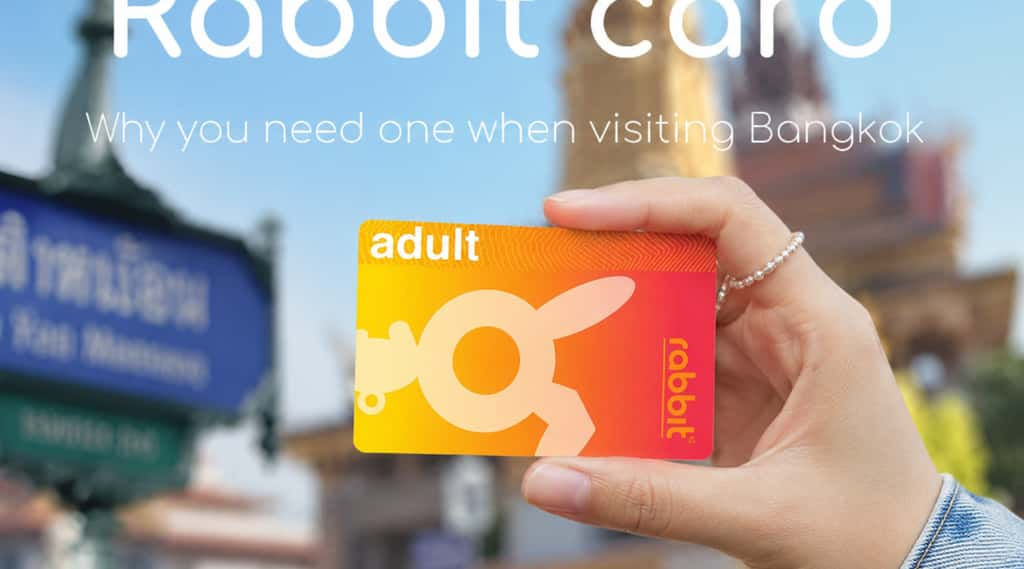
A Bangkok Rabbit Card costs ฿200 (about US$6): a ฿120 card fee plus ฿80 of stored value, topped up afterwards in multiples of ฿100. It is a reloadable stored-value card mainly designed for BTS Skytrain travel.

It is not an unlimited travel pass, and it is not a universal Bangkok transport card.
For tourists, its main benefit is convenience:
- load money once;
- tap through supported gates;
- avoid buying individual tickets for every BTS journey.
The key question is not simply:
“Does Rabbit Card save money?”
The better question is:
Will you use BTS often enough that the convenience is worth the card fee?
Best choice for most travellers
- Choose Rabbit Card if you will use BTS repeatedly over several days.
- Choose BTS One-Day Pass if you have one BTS-heavy sightseeing day and the current pass price is lower than your expected BTS fares.
- Skip Rabbit Card if your itinerary mainly uses MRT, taxis, buses, Grab, or Airport Rail Link.
Bangkok Rabbit Card: Quick Answer
The current standard Rabbit Card is sold for ฿200:
- ฿120 card issuance fee
- No refundable deposit
- ฿80 initial stored value, with top-ups in multiples of ฿100
The important distinction:
- the card fee gives you the physical Rabbit Card;
- your stored balance is the money used for transport.
For example:
If you buy a new card for ฿200:
- ฿120 = card issuance fee
- ฿80 = usable transport balance (top up more in multiples of ฿100)
For visitors staying several days and using BTS frequently, paying the issuance fee can make sense because the card removes repeated ticket purchases.
For visitors making only a few BTS trips, individual tickets may be simpler.

What Is a Rabbit Card?
A Rabbit Card is a reusable stored-value smart card.
You add money to the card, then the fare is deducted when you use supported services.
Rabbit is mainly useful for:
- BTS Sukhumvit Line
- BTS Silom Line
- BTS Gold Line
- selected Rabbit-supported transport services
- participating Rabbit payment merchants
The most important point:
Rabbit Card is a convenience tool, not an unlimited travel pass.
Buying one does not automatically make every Bangkok journey cheaper.
Is Rabbit Card Mainly for BTS?
Yes.
For most tourists, Rabbit Card should be viewed as a BTS Skytrain card first.
It is especially useful for areas such as:
- Siam
- Chit Lom
- Asok
- Phrom Phong
- Thong Lo
- Ekkamai
If your itinerary is mainly:
- shopping malls;
- restaurants;
- BTS-connected neighbourhoods;
Rabbit fits naturally.
If your itinerary focuses on:
- Chinatown;
- Chatuchak Weekend Market;
- MRT Blue Line attractions;
- Airport Rail Link;
Rabbit may not be the card you use most.
The better approach is:
Plan your routes first, then choose your transport card.
Where Can You Use Rabbit Card in 2026?
Rabbit Card currently supports:
- BTS Sukhumvit Line
- BTS Silom Line
- Gold Line
- MRT Yellow Line
- MRT Pink Line
- BRT
- selected Chao Phraya boat services
Rabbit coverage should not be interpreted as:
“one card works everywhere in Bangkok.”
That is one of the most common tourist mistakes.
Can Rabbit Card Be Used on MRT Bangkok?
This depends on the MRT line and payment method.
Older Bangkok transport advice often simplified this as:
“Rabbit does not work on MRT.”
That is no longer the complete picture.
Many MRT journeys now support EMV contactless payment with compatible bank cards, including major MRT lines such as Blue, Purple, Yellow and Pink. On the Blue and Purple lines, foreign credit cards work but debit cards are accepted only from five Thai banks, so a foreign debit card won't open the gate. On the Yellow and Pink lines, tap in and out with the same card or you're charged the maximum fare (BEM and line operators, checked 15 November 2026).
For many visitors, the easiest setup is:
Rabbit Card for BTS + contactless credit card for MRT
rather than trying to force one card to cover every system.
Choose based on your itinerary:
- Mostly BTS → Rabbit Card makes sense.
- BTS + MRT combination → Rabbit plus a contactless credit card is usually simpler.
- Mostly MRT → Rabbit may not be necessary.
Can Rabbit Card Be Used on Airport Rail Link?
Do not buy Rabbit Card specifically for Airport Rail Link.
The Airport Rail Link is a separate system.
A Rabbit Card pickup location at Suvarnabhumi Airport does not mean Rabbit can pay for your airport train journey.
Arrival day tip:
If you land at BKK and plan to take Airport Rail Link into Bangkok, prepare another payment method first.
Buying Rabbit Card: Station vs Online Pickup
Buy at a BTS Station if:
- you are already in Bangkok;
- you want the standard official purchase route;
- you are unsure whether Rabbit will be useful;
- you do not want to arrange pickup.
Choose online pickup if:
- you already know you want Rabbit;
- the pickup location matches your arrival route;
- the price difference is reasonable.
Do not compare only the ticket price.
Check:
- final checkout price;
- included stored value;
- pickup location;
- whether the product is actually Rabbit Card or BTS One-Day Pass.
Important: Check Product Names Carefully
Some travel platforms use similar wording for different products.
Before purchasing:
Rabbit Card
Look for:
- stored value;
- reload;
- top up;
- physical Rabbit Card.
BTS One-Day Pass
Look for:
- unlimited rides;
- one-day validity;
- activation day usage.
These products solve different problems.
Rabbit Card = flexibility.
BTS One-Day Pass = unlimited BTS travel for one intensive day.
Rabbit Card Registration for Foreign Tourists
Registration is optional. It lets Rabbit refund the remaining balance if the card is lost or stolen; you don't need it to ride or top up (Rabbit, checked 15 November 2026).
To register, bring your:
- original passport;
- contact information.
If you'll load more than a small balance, registering is worth the few minutes for the lost-card refund.
How Much Should You Top Up?
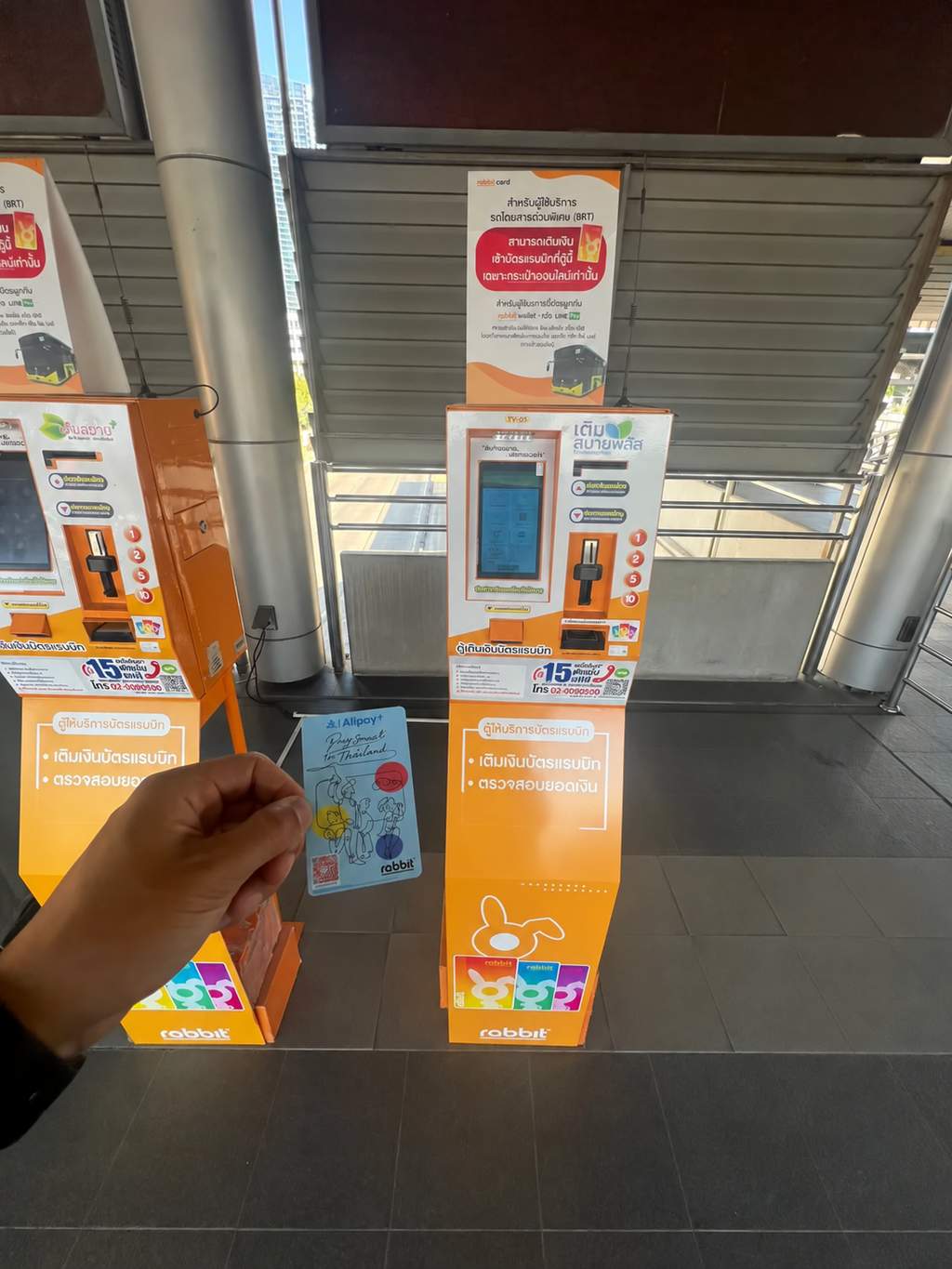
Rabbit top-ups are made in multiples of ฿100, and the stored-value balance is capped at ฿4,000.
For tourists, avoid loading a large amount immediately.
A practical strategy:
- Estimate your BTS usage.
- Add a small buffer.
- Top up again if needed.
This reduces leftover balance problems at the end of your trip.
Rabbit Card vs BTS One-Day Pass: Which Should You Buy?
They are designed for different travel styles.
Rabbit Card is better when:
- you stay several days;
- BTS trips are spread across multiple days;
- you want flexibility;
- some days only require one or two rides.
BTS One-Day Pass is better when:
- you have one sightseeing-heavy BTS day;
- you will make many BTS journeys;
- unlimited rides match your route.
The calculation is simple:
Expected BTS fares for that day > One-Day Pass price
→ compare the One-Day Pass.
Expected BTS fares for that day < One-Day Pass price
→ Rabbit or individual tickets may cost less.
Best Strategy for a Multi-Day Bangkok Trip
Many visitors do not need to choose only one.
A practical combination:
Rabbit Card for normal days + BTS One-Day Pass for one extremely BTS-heavy day
This avoids paying for unlimited travel when you do not need it.
Is Rabbit Card Worth It?
Rabbit Card is worth considering if:
- you stay several days;
- BTS is your main transport;
- you want faster station entry;
- you prefer not buying tickets repeatedly.
Rabbit is less useful if:
- you only take a few BTS trips;
- your itinerary mainly uses MRT;
- you mostly use taxis or Grab.
The biggest misunderstanding:
Rabbit is not valuable because it automatically makes Bangkok transport cheaper.
Its value is:
convenience + repeated BTS access.
Final Verdict
For visitors staying several days in Bangkok and regularly using BTS, Rabbit Card remains a practical choice.
However, do not treat it as a universal Bangkok transport card.
The simplest decision:
- Mostly BTS → Rabbit Card
- One BTS-heavy sightseeing day → compare BTS One-Day Pass
- Mostly MRT → use MRT payment options
- Airport transfer → use Airport Rail Link payment separately
For many travellers, the easiest setup is:
Rabbit Card for BTS + contactless credit card for MRT.
FAQ
Can tourists buy a Rabbit Card in Bangkok?
Yes.
Foreign visitors can buy Rabbit Cards. Registration is optional and only protects the balance if the card is lost.
Can Rabbit Card be used on MRT Bangkok?
Only on supported services.
For many MRT journeys, a contactless credit card is now the simpler option. Foreign debit cards don't work on the Blue and Purple lines.
Can Rabbit Card be used on Airport Rail Link?
No.
Use a separate payment method for Airport Rail Link.
Does Rabbit Card give unlimited BTS rides?
No.
Rabbit is stored value.
For unlimited BTS travel on one day, compare the BTS One-Day Pass.
How much does a Rabbit Card cost?
The current standard card issuance fee is ฿120.
The card is sold for ฿200, which includes ฿80 of stored value; further top-ups are in multiples of ฿100.
How much should I top up?
Start with a small balance.
Most tourists do not need to load large amounts before knowing their actual BTS usage.
Is Rabbit Card valid for future trips?
Rabbit Cards have a validity period, but travellers should check current conditions before using an old card after a long break.
Written by

Former KLOOK Recommender System Expert
Built the systems that decided which products ranked first for users in KLOOK. That experience taught me that rankings just optimize clicks and conversions for OTA — not necessarily what truly fits each traveler. Today, I write evidence-based verdicts using my 4 year experience on product: whether they're worth it, who they suit, and when you're better off skipping them.